Windows for Thailand's rainy season: where the water actually gets in
Wind-driven rain does not fall on a window, it is pushed into it. Four entry paths, the details that stop them, and a pre-season checklist you can run in an afternoon.
Read more
Two quotes for the same villa can differ by 300%. Here is the cost structure behind a per-square-metre price, and how to compare two quotes without being fooled by the cheap one.
If you collect five quotes for the same villa in Thailand, the cheapest and the most expensive will often differ by a factor of three. Almost none of that difference is profit. It is the specification hiding behind a single number: "THB 4,500 per square metre" tells you nothing until you know what is inside the frame.
Windows do not scale linearly. A 1.2 × 1.2 m casement and a 3.0 × 2.6 m fixed panel use similar amounts of glass, but very different amounts of profile, hardware, labour and risk. Most factories price on a mix of area and perimeter, then present an average. That is fine — as long as you compare the same window schedule, with the same glass, at the same size.
The second problem is what the price excludes. In Thailand, a factory quote may be ex-works Foshan, FOB, CIF Laem Chabang, or delivered and installed. Those four numbers can differ by 35–50% before anyone has discussed performance.
6063-T5 primary aluminum with a 1.4 mm wall is not the same product as 1.2 mm recycled billet, even though both are sold as "aluminum window profile". Wall thickness drives wind-load performance more than any other single variable, and it is the first thing a low-cost supplier reduces. On a 2.0 mm system window, the aluminum alone can be 40% of the material cost.
A polyamide strip (PA66 GF25) that separates the inner and outer aluminium adds cost in two places: the strip itself and the knurling/rolling step that fixes it. Windows sold as "thermal break" sometimes use a PVC strip, which softens at the temperatures a dark frame reaches in direct sun.
This is where quotes diverge most. Common builds in Thailand, from cheapest to most expensive:
The gap between 5 mm single and 6+12A+6 Low-E can be USD 25–45 per square metre on its own. That is often larger than the entire margin difference between two suppliers.
A casement sash needs hinges, a multi-point lock, a handle and sometimes a restrictor. Hardware ranges from unbranded zinc-alloy sets to German systems, and the spread is USD 15–60 per window. On coastal projects, stainless internals are not optional — salt mist destroys plated zinc parts within two or three seasons.
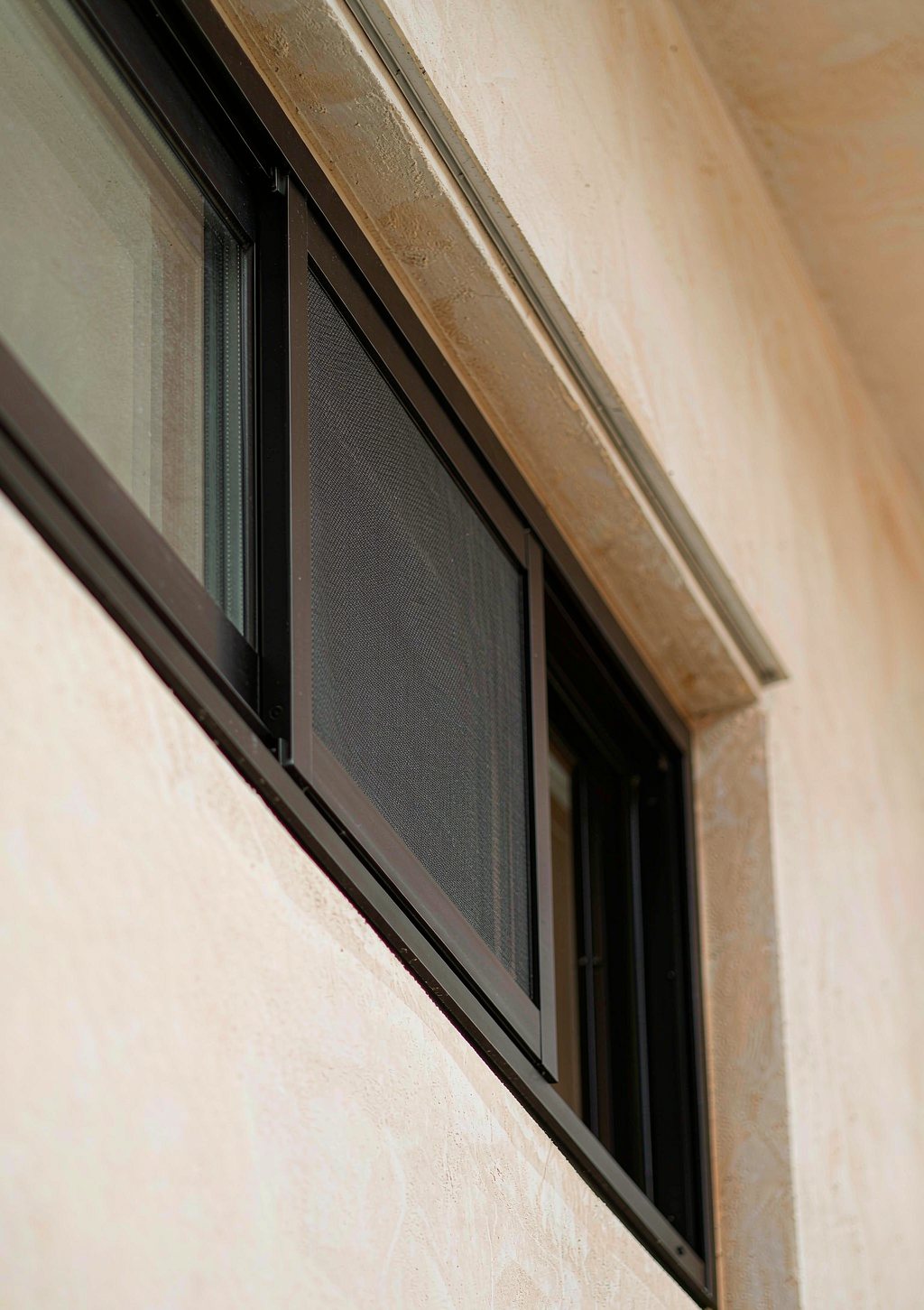
In Thailand the screen is not an accessory. A bolt-on fibreglass roll is cheap; a 304 stainless mesh running in its own track inside the frame is not. Expect a meaningful difference in both price and how the window looks from inside.
Standard powder coating at 40–60 μm is the baseline. A 60–80 μm marine-grade coating, anodising, or wood-grain sublimation adds cost but changes how the frame looks in year five. On a coastal project, the cheaper coating is the expensive decision.
Complete aluminum windows and doors enter Thailand under HS 7610.10. Duty depends on the applicable rate and origin documentation; VAT is 7%. Sea freight from South China to Laem Chabang is modest per container but not per square metre — a container full of large fixed panels carries far more area than one full of small casements. Installation, scaffolding and making good the opening are usually 15–25% of a delivered-and-installed price, and are the first thing dropped from a "cheap" quote.
These are order-of-magnitude ranges for factory-direct supply from China, FOB South China, in USD per square metre, for a project of 100 m² or more. They are not a quotation: sizes, glass, colours and quantity move the number materially.
| Configuration | Indicative FOB band | Typical use |
|---|---|---|
| 65 series casement, 1.5 mm, 6+12A+6 clear | USD 95 – 135 / m² | Self-built houses, volume housing |
| 65 series casement, 6+12A+6 Low-E | USD 115 – 165 / m² | West-facing bedrooms |
| 92 series three-track slider, 1.4 mm, 5+9A+5, screen | USD 110 – 155 / m² | Balconies, living rooms |
| YFG90 system window, 2.0 mm, 5+20A+5, flush screen | USD 175 – 250 / m² | Villas, seafront, hotels |
| 68/75 folding door, 2.0 mm, 6+12A+6 | USD 190 – 280 / m² | Living room to terrace |
| 16 series narrow-frame interior door, 8 mm tempered | USD 210 – 320 / m² | Offices, fit-out |
Add roughly 8–12% for freight and insurance to Laem Chabang, then duty and 7% VAT, then installation if you need it. A useful sanity check: if a quote for a 2.0 mm system window with Low-E glass lands below the 65-series band above, something in the specification has been changed — and it is worth asking what.
Ask what happens in year four when a roller fails or a gasket compresses. A window is a mechanical assembly with moving parts, and the cheapest quote is usually the one with no plan for that. Spare parts availability, a named contact and a written warranty period are worth more than a 5% discount — particularly on a project where a failed sash means a room cannot be closed during the monsoon.
If you send us a window schedule, we will return a configuration proposal with the glass build, wall thickness and hardware written line by line, so it can be compared against any other quote on equal terms.
Wind-driven rain does not fall on a window, it is pushed into it. Four entry paths, the details that stop them, and a pre-season checklist you can run in an afternoon.
A thermal break is not a marketing word — but it is also not the biggest variable in a Thai window. Here is where the heat actually comes through, and what to spend on first.
WhatsApp a photo with dimensions, or send drawings and a window schedule. You will get a configuration proposal, a per-square-metre price and a delivery date — usually within 12 working hours.